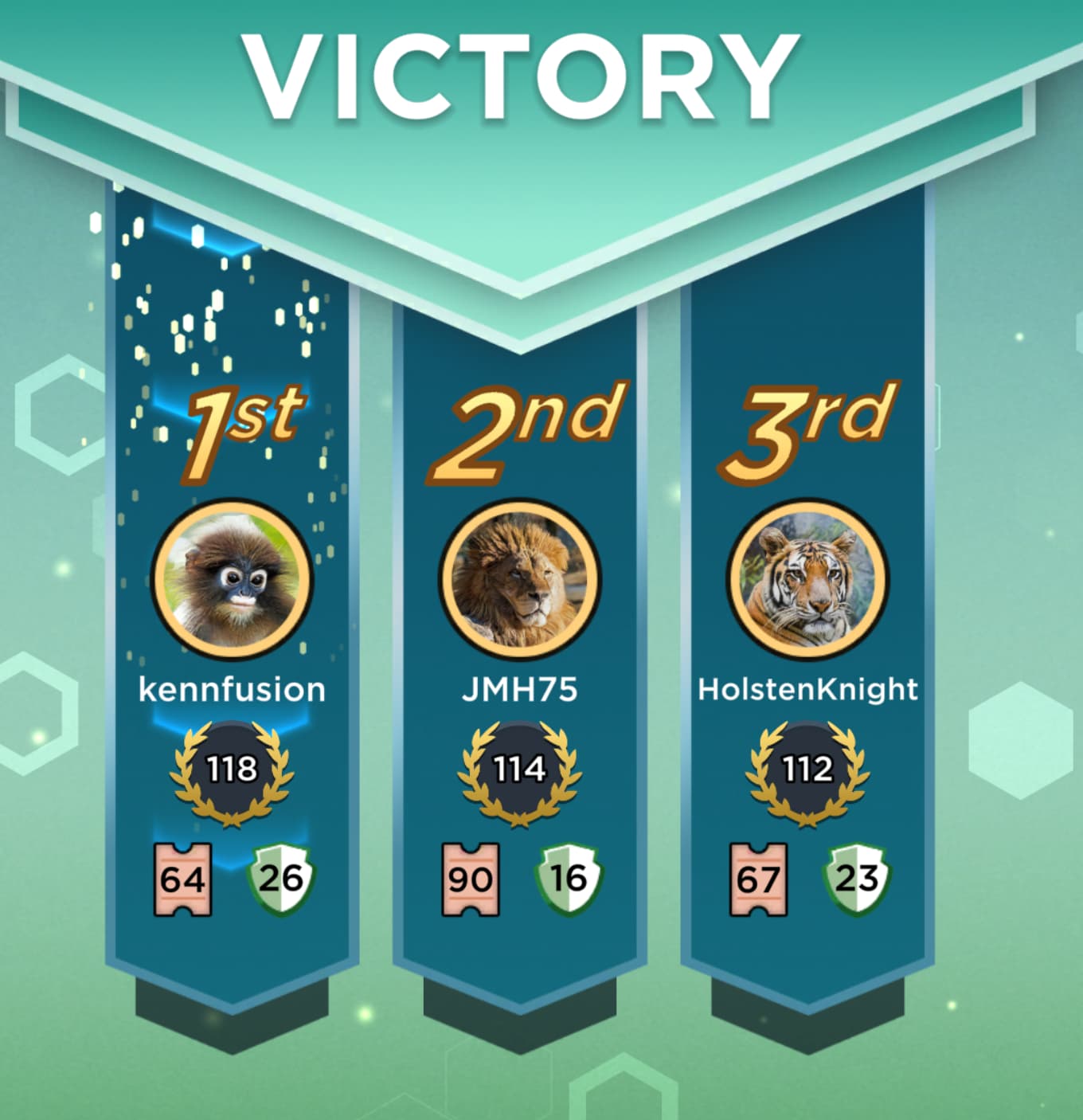
I don’t remember the details from the match, but I will point out that conservation points are essentially only worth 2 points each until you get over 8 conservation points, but 3 points for every one after that. You need to get those up higher faster, even by taking low point value conservation projects to get the extra point value, as well as the break bonuses and the 5 and 8CP bonus tiles. it is possible to win with a low CP game, but it usually involves getting a high income so you can play a ton of better quality animals.
I suppose I used a lot of words to say “just get more points!”…
Thanks @Hardco and @rinelk - a fun game, as usual. At least a couple of big turns from Hardco near the end including a game-end-triggering double animal for a breathtaking combination of CP and Tickets and Reputation… I felt lucky just to get close to 100!
Also appreciate the analysis from Hardco, as always - for my part, I tend to focus a bit too much on CP as you can see by the fact that the gap here was all Tickets.
The only other thing I will add is that I read early on when learning this game that the best piece of advice is that, despite the length of the game, it is definitely a RACE to the end not a leisurely meander to make the nicest zoo.
@Hardco, this is undoubtedly excellent advice. For reasons I don’t entirely understand, I find Ark Nova tremendously satisfying to play with quite a superficial understanding of the scoring, and it’s left me with little motivation to be smarter about it.
Hey, I finally won a game! GG @JMH.75 and @HolstenKnight - super close all around. I was able to fill my board on that last turn which got me ahead at the very end.
Really fun game, all 3 so close the whole game. I knew I probably should not end the game, but I just used all cards. So I would need at least 2 more turns for anything.
My earlier reply sat a little oddly with me, in the way I’ve come to recognize as a sign that further thought might be productive.
I generally dislike VPs as an inelegant kludge; ideally, actions in game would connect with some easily-observed, obviously valuable success in the game, such that VPs are unnecessary. Race games, for example, do this well. That said, I recognize that they’re sometimes the best known option; the game on my table right now is Coast Watchers, and VPs in that game essentially abstract out your effect on the wider war, which would be cumbersome and beyond the scope of the game to simulate.
Better even than race games are games which give you a bunch of pieces and systems which are hard to manage, and tell you to make something cool, because simply making that happen is very satisfying. The game itself feels like it’s telling you what playing well is; VPs are at best epiphenomenal, and at worst actively undermine the message the game itself is telling.
I think the apex of my indulgence in this perspective came during college, when I managed to cultivate a group of Magic players who effectively never used removal. We would all compete to build up our decks and make them do the cool stuff which the game allowed and which offered the most satisfying intrinsic rewards, and really didn’t enjoy preventing one another from doing that. And that let us explore a wide array of “non-viable” decks, which felt like a much fuller way to enjoy the game than the other guys I knew who built a deck which they did a bunch of math on, and which could cause the opponent to either concede or ante their entire deck with (IIRC) 95% probability on turn one. I get that breaking the game this way is also satisfying; I think they were genuinely having fun doing it. But that sort of analysis was in tension with my preferred, more superficial pleasure—it required seeing through the game, rather than going along with it.
My hypothesis about why this all feels so fundamental to me is that it feels like ethics. The whole project of ethics as usually practiced involves taking our pretheoretic intuitions about right and wrong, and just cleaning them up a little into neat, easily applied maxims to help us avoid bias. For me, the sensation of sequencing the building of new enclosures, installation of animals, and management of funds with no wasted actions feels right in much the way that feeding the hungry feels right—it’s the sort of intuition which I want to be able to capture in my moral theory. If it turned out that VPs made slotting all those actions together perfectly not right, it would be troubling in much the way that it’s troubling to learn your preferred ethical theory makes feeding the hungry evil. Maybe you could big-brain your way to understanding how that could be bad (and I genuinely believe that it’s plausible, in certain circumstances, with certain alternatives). But it requires a lot of convincing to continue to accept an ethical decision machine which spits out “don’t feed the hungry” rather than to regard this as a reason to abandon the machine.
Buried under all this is my anxiety that the whole project of ethics as usually practiced is nonsense. Our intuitions are sufficiently inconsistent and ill-founded that there likely is no simple, easily-applied maxim we could use to capture them. Avoiding bias in this way is likely just impossible. Probably there is no objective morality to which our intuitions give us any access, and, if there have been contexts in which acting like there was was close enough, we are outside that context now. So, probably nothing I do can be compared to any broader standard with any legitimacy—fundamentally, nothing matters.
VPs which stand in tension with the intrinsic satisfaction the game provides raise in me the specter of nihilism, to which my only response is insistence on the value of my superficial impressions.
“it would be troubling in much the way that it’s troubling to learn your preferred ethical theory makes feeding the hungry evil.”
For the record, I am sure I could find a situation where from a Deontological perpspective (my preferred ethical theory (with some caveats)) feeding the hungry would be inherently evil based on some maxim I constructed.
The problem (in my mind), is that while you can engage with a game however you find it satisfying, you are still playing a game where the goal is to win, and if you aren’t trying to do that you may be negatively affecting everyone else’s experience. If as a group you want to rewrite the rules of MTG to “play no removal”, at least there is an agreement in the rule change, and everyone can try to win following those rules. But if we are all playing a game with a known ruleset, we should be equally using those rules to try to win rather than choosing which ones to engage in. Sure drafting in Heat to slipstream to cross the finish line first may be more thematically satisfying than hanging around 2nd/3rd place in Power Grid to economically leapfrog to victory, but we all know the rules and should use them to do our best.
Personally, I find the point system in Ark Nova more thematic than most games though. Having animals increases the appeal of your zoo, and you gain conservation points by protecting more endangered animals. You can even release them back into the wild to improve your conservation efforts at the sacrifice of the appeal of your zoo!
Do you feel as though the negative impact you’re referring to comes from facing inadequate opposition itself (presumably because poor competition reduces the information learned by the result of various strategies), or because others not valuing the things we value (in this case, VPs) reduces our own perception of that value and thereby edges up against the sort of nihilism that looms for me, or out of the resemblance to the sort of “Oh, it’s nice that you won, I wasn’t trying to” kind of reaction to losing which sometimes half-clever adolescents use to salve their egos?
In any case, my opposition isn’t absolute. I just focused on other stuff than VPs when I was going through the tutorials, because there was enough going on that I couldn’t really internalize it all. I still don’t actually know the difference between the green ones and the tickets. So I feel like, if I want to get a clearer handle on anything VP-related, I probably have to go back and relearn a bunch of stuff, which always sounded sort of exhausting and I didn’t see much reward. But since I can think of a few ways that might be kind of a dick move, as listed above, I’ll check it out again.
Well when you are still trying to learn the game things are different. Especially if a game has a lot of systems, you are spending the whole game trying to understand the interactions. But if you are playing a 3 person game, and only 2 of the players are trying to win, that’s going to be a lesser “gaming” experience to me than 3 people actively competing to win. I feel like I am using a lot of words when the oft-quoted Knizia line is so succinct: “When playing a game, the goal is to win, but it is the goal that is important, not the winning”.
Maybe I’m just hung up on the “playing MTG with no removal” discussion, and I’m missing the bigger picture with the ethics side of things…
How would you feel about a game in which a player, having seen some cards which specify benefits for covering the whole map, but never having done so, resolved to make that their first priority, because they wanted to see how hard it would be and whether it was a viable strategy?